BuyLow Signals runs a stock through a set of strategy-specific conditions — value, momentum, or dividend — and produces a BUY, HOLD, or SELL signal. Every signal shows the exact conditions that passed or failed and the raw data behind each one. The scoring is deterministic: identical inputs always produce identical outputs, regardless of who is running the analysis.
What “transparent” actually means
Most stock screeners give you a score or a verdict. BuyLow Signals gives you the reasoning. If a stock scores as a BUY on the value strategy, you see which conditions triggered it: the P/E ratio, the price-to-book, the debt levels and the actual numbers behind each condition. Nothing is weighted in the background. Nothing is hidden in a proprietary model.
How the Strategy Scoring Works
Each strategy is a set of conditions. A stock either meets a condition or it doesn’t. The signal reflects how many conditions are met and how strongly.
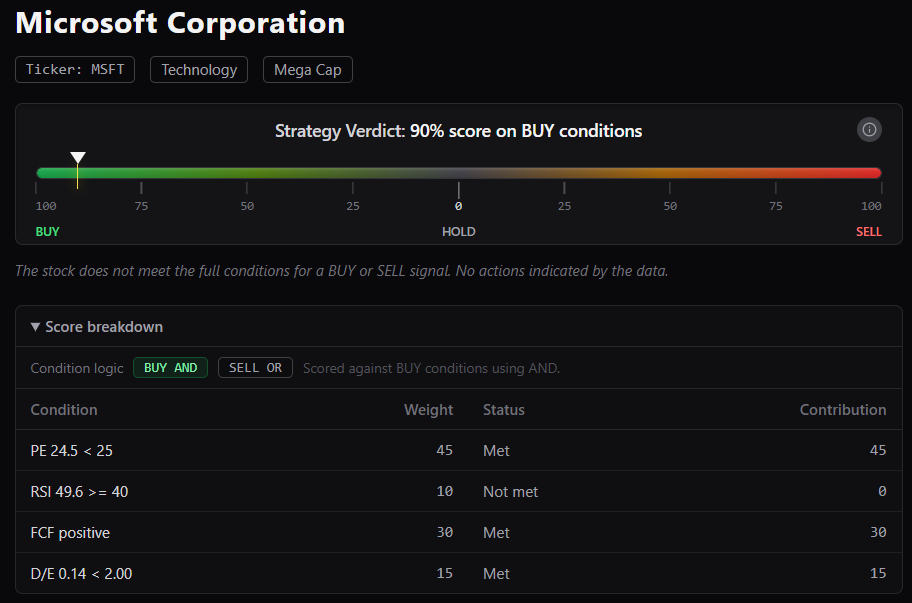
The above image is an example which shows the the Value strategy run results for Microsoft. Every strategy has its own parameters and thresholds. The real values are measured against the thresholds and conditions. Based on how they are met, the final score for strategy is tallied.
The Strategies
BuyLow Signals organizes strategies into four tiers:
System strategies are the core built-in screens available to all users: Momentum (stocks gaining strength), Value (stocks trading below fair value), and Dividend (income-focused stocks with sustainable payouts). These cover the three most widely used investment frameworks and are designed to work across the broad market.
Advanced strategies are curated screens for specific sectors or sub-theses where a general strategy would produce misleading signals. Examples include Value — Financials (which uses bank-appropriate metrics instead of standard PE ratios), Value — Real Estate (anchored on yield and payout durability for REITs), Value — Energy (EV/EBITDA and cash flow focused), Value — Defensive (quality-led for low-growth sectors), Growth (accelerating revenue and earnings), and Dividend — High Yield (for cash-stable, regulated sectors). These are available on paid tiers.
Forked strategies are user-created variants of any system or advanced strategy. A fork lets you adjust thresholds, add or remove conditions, or shift weights to express your own thesis within a sound structure. The base strategy provides the framework; the fork makes it yours. Forks are saved to your account and run identically every time - same inputs, same output.
Custom strategies are built from scratch using the strategy builder. You define the conditions, the thresholds, and the logic. This is for investors with a specific analytical framework that doesn’t map to any existing strategy.
Who it’s for
Self-directed retail investors who want analytical rigor without a Bloomberg terminal. Investors who want to understand why a stock passes or fails a screen, not just that it did.
What it is not
BuyLow Signals is an analytical tool, not a financial adviser. Signals are identical for identical inputs regardless of who is running them. Nothing on the platform constitutes personalized investment advice.